Running Toilet Repair in Fountain Valley, CA
📞 Call Now — (714) 410-0362A running toilet is fixed by finding which part lets water escape — worn flapper, faulty fill valve, or a level set too high — and replacing or resetting only that part.
Why your toilet will not stop running
A toilet should fill once after a flush, then sit silent until the next flush. When you hear water moving between flushes, something inside the tank is letting water escape — and only a few parts can be at fault.
Inside the tank, the system is simple. The fill valve lets water in and shuts off at a set level. The flapper seals the flush opening at the bottom of the tank. The overflow tube is the safety path: if the water climbs too high, it spills down that tube into the bowl. A running toilet means one of those three is failing.
Patterns that point to the cause:
- The toilet runs nonstop and never shuts off at all
- It refills on its own every so often, even when no one flushed
- You hear a faint hiss from the tank between flushes
- Water trickles down the inside wall of the bowl in a thin stream
- Jiggling the handle stops the running — for a while
- The tank takes a very long time to fill after a flush
A toilet that never stops usually has water spilling over the overflow tube because the fill valve will not shut off, or the water level is set too high. A toilet that refills on its own in cycles — often called phantom flushing — is losing water slowly past the flapper. The tank level drops over an hour or two, the fill valve wakes up, tops it off, and the cycle repeats all day and night.
The flapper is the usual suspect. It sits in treated water day and night, and rubber does not age well that way. It warps, hardens, blisters, or picks up a rough edge of mineral scale, and then it cannot seal. Water slips past it in a slow, silent stream that you may never see unless you look for the ripple in the bowl.
The chain matters too. A chain that is too long can slide under the flapper and hold it open a crack. A chain that is too short can keep the flapper from seating fully. Both faults look like a worn flapper from outside the tank, which is why a proper check looks at the chain before any part gets replaced.
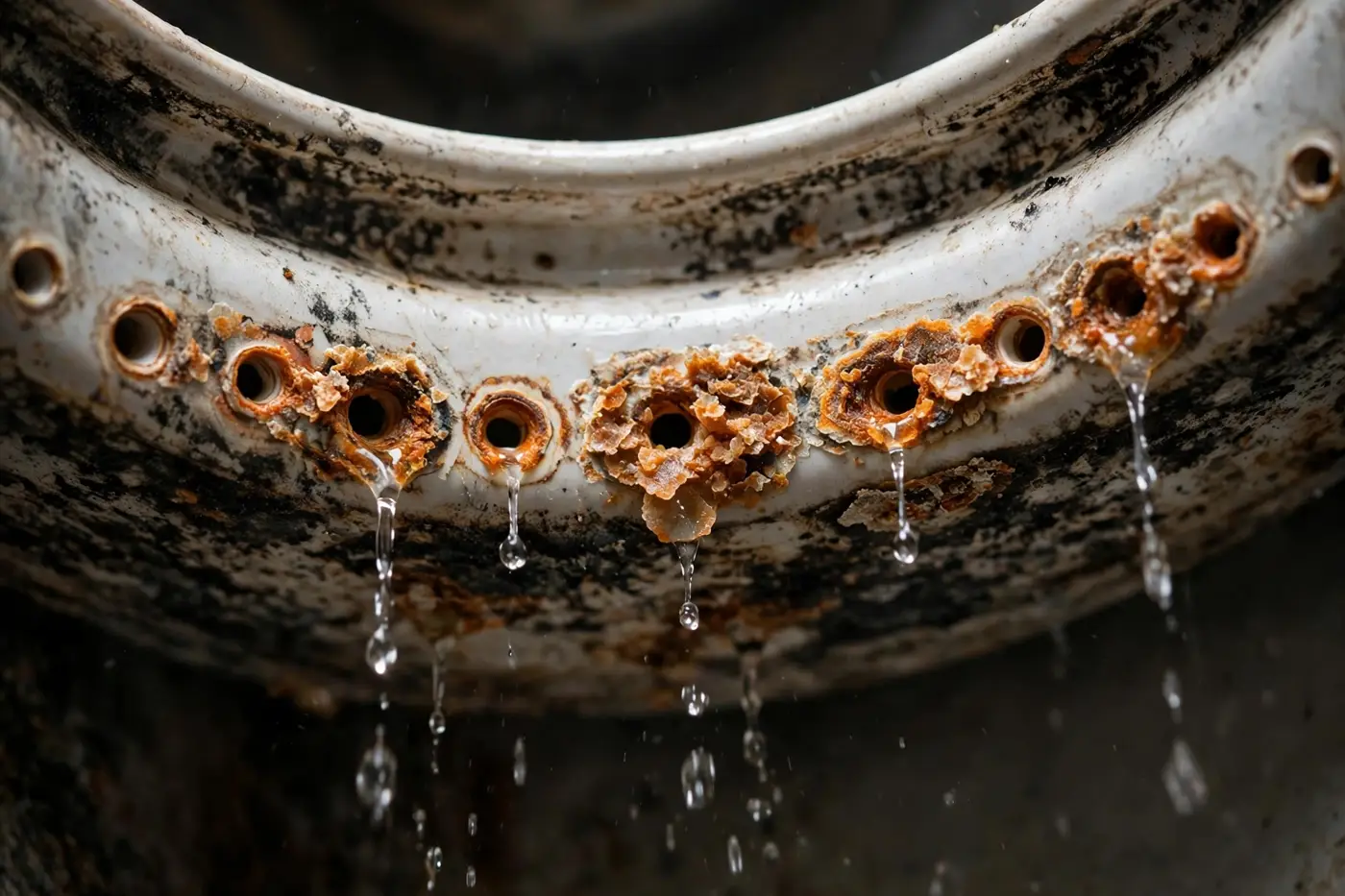
Fill valves fail in their own way. Their washers harden, grit from the water supply gets into the seal, and the valve starts to hiss, fill slowly, or refuse to shut off at the set level. In Fountain Valley, hard water speeds this up: mineral grit and scale build inside the valve and on the flapper seat faster than they do in soft-water areas.
None of these faults fix themselves. Every one of them gets worse slowly, and the toilet uses more water each week while it waits.
From phantom refills to a tank that holds its level
The fix is proven by silence: a repaired tank fills once, shuts off clean, and stays quiet for hours — no refills, no hiss, no ripple in the bowl.
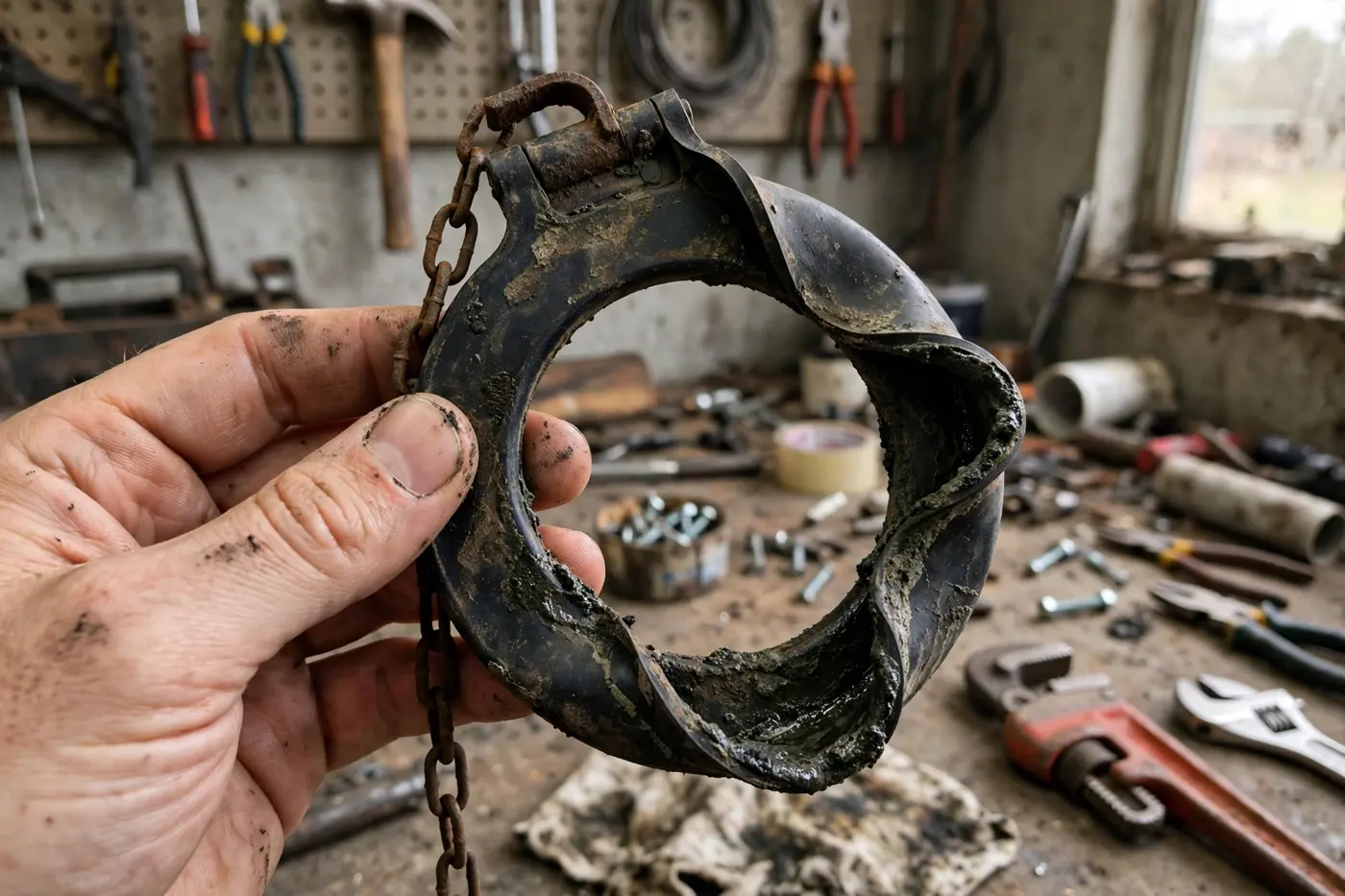
The old flapper is warped and rough at the edge. It cannot seal, so tank water slips into the bowl all day. The fill valve wakes up again and again to top off the tank, and the toilet refills on its own through the night.
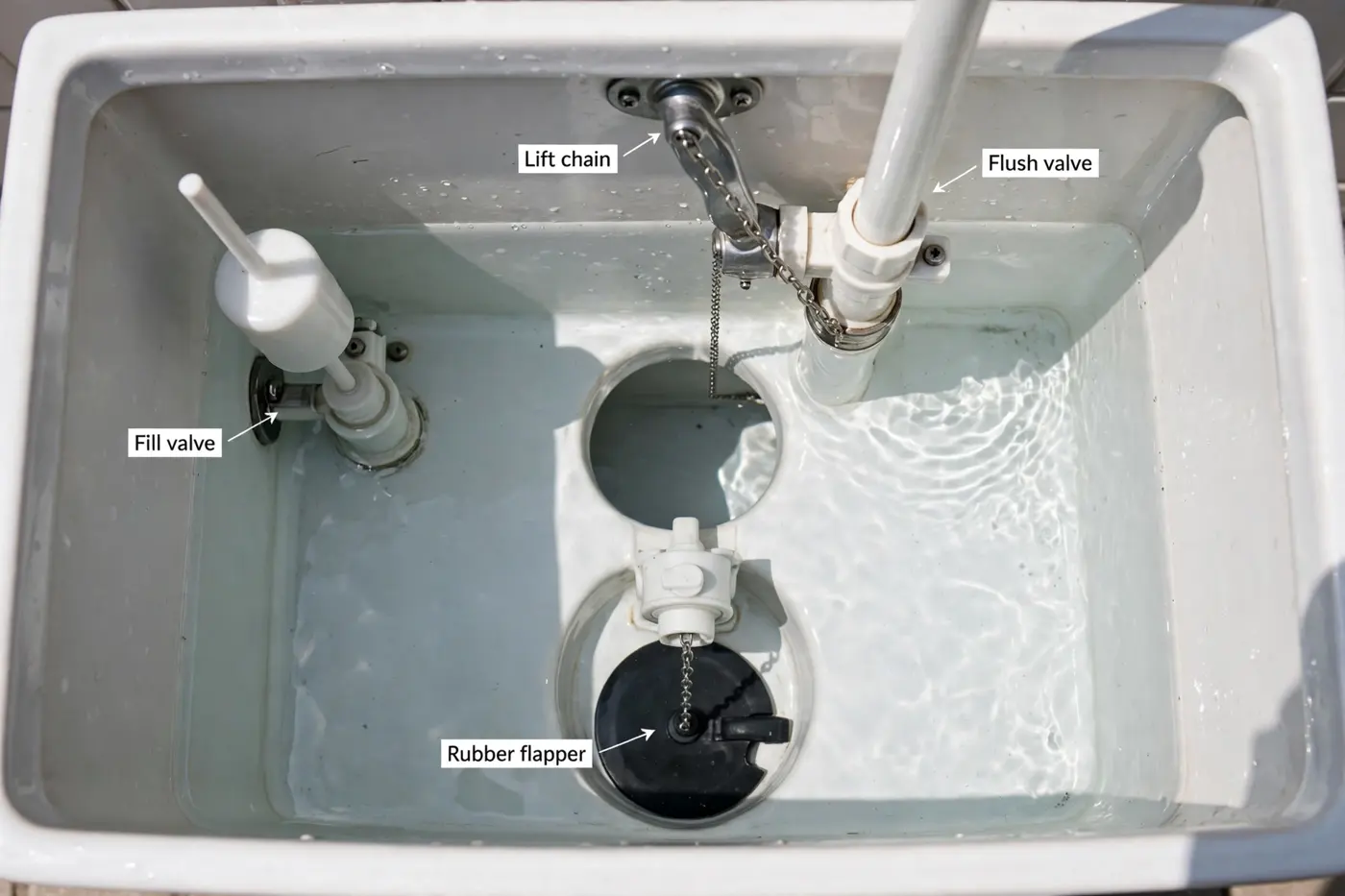
The worn parts are replaced, the chain is set with the right slack, and the water level is set about an inch below the overflow tube. The tank is dye-tested and watched through a full cycle: it fills once, shuts off, and holds.
Dye is the honest test here. A few drops of food coloring in the tank, a wait of fifteen to twenty minutes without flushing, and any color that shows in the bowl proves water is still slipping past the seal. A repair that passes the dye test and a full quiet cycle is a repair you do not have to wonder about.
How a running toilet repair visit works
One call connects you with a local toilet specialist. Here is the visit, step by step.
Step 1 — The call and the pattern questions
You call (714) 410-0362 during open hours and describe the pattern: running nonstop, refilling on its own, hissing, or stopping when you jiggle the handle. Each pattern points to a different part, so those details help the technician plan the visit and bring the right parts along.
Step 2 — Tank level and a first listen
The technician lifts the tank lid and checks the water level against the overflow tube. A level that sits too high explains a lot on its own. The fill valve is watched and listened to as the tank fills, because a valve that hisses or will not shut off tells on itself during a live cycle.
Step 3 — The dye test
Color is added to the tank water and the toilet is left unflushed for a set time. If color appears in the bowl, water is slipping past the flapper or the flush valve seat. If the bowl stays clear, the fault sits with the fill side instead. The scope of any part replacement is confirmed with you before any work starts.
Step 4 — Replacing the failed part
The water is shut off at the valve behind the toilet, the tank is drained, and only the failed part is changed: flapper, fill valve, or the flush valve seat if it is pitted or rough. The chain is set with a small amount of slack so the new flapper can seat fully every time.
Step 5 — Setting the water level
The fill level is set about an inch below the top of the overflow tube. That level gives a full, strong flush without spilling a drop between flushes. In a home with hard water, the seat under the flapper is also wiped and checked for scale that would spoil the new seal.
Step 6 — A watched fill cycle and a second dye check
The toilet is flushed and the whole refill is watched from start to shut-off. The tank must fill once, stop clean, and stay silent. A short second dye check confirms the new seal holds, and the base and supply line are checked dry so the visit ends with no leaks and no running.
Safe checks you can do — and where to stop
The tank is one of the friendliest parts of a home to check yourself. Nothing inside it is under pressure once the lid is off, and three quick checks find most running-toilet faults.
Checks that are safe to try
- Lift the tank lid and look at the water level: it should sit about an inch below the overflow tube
- Run a finger around the flapper edge — warps, blisters, and rough spots mean it is done sealing
- Check the chain: it needs a little slack, and it must not slide under the flapper
- Do the dye test: food coloring in the tank, wait twenty minutes, look for color in the bowl
- Turn the shut-off valve off overnight if the running is heavy, so water is not wasted while you sleep
Swapping a flapper is a fair home job on many toilets: shut the water off, unhook the old flapper, hook the new one in its place, set the chain, turn the water back on. If that is where your comfort ends, that is a fine place to end — the rest of the tank rewards a trained eye.
Where to stop and call
- The shut-off valve will not turn, or it leaks when you turn it
- Water runs over the overflow tube no matter how you set the level
- The new flapper still leaks because the seat under it is pitted or rough
- Water appears on the floor, at the base, or on the ceiling below
- The fill valve screeches, hammers, or fills slower every week
- You hear running from more than one toilet in the home
Water on the floor is a different problem than water running inside the tank. Floor water points to a seal or supply fault, covered on our toilet leak repair page. Inside-the-tank running stays a parts problem, and parts problems have clean, testable fixes.
Heavy running right now? Turn the valve behind the toilet clockwise until it stops. The tank will not refill, the waste stops at once, and the toilet can still be flushed one last time with the water already in the tank.
The water math: what a running toilet really wastes
A running toilet sounds like a small thing. The gallons say otherwise. Here is the simple math, and why the phantom flushing you hear at night is the clue that gives it away.
Start with a toilet that will not stop at all — water flowing over the overflow tube in a steady stream. That stream looks thin, but it runs every minute of every hour. A flow like that can send hundreds of gallons down the drain in a single day. Left for a month while a family is away or a spare bathroom sits unused, the total climbs into the thousands of gallons, all of it treated, pumped, and paid for, none of it ever used.
The quieter fault wastes less per hour but hides far longer. When a flapper leaks slowly, the tank loses a small amount of water, the fill valve tops it off, and the cycle repeats. Owners often hear it first at night, when the house is quiet: a toilet that flushes itself in an empty bathroom. That phantom flush is the fill valve replacing the water the flapper let slip away. Each refill may be small, but a cycle that repeats every hour or two, through the day and night, still adds up to a large daily total — and it never takes a day off.
Fountain Valley adds a local twist. City water is hard — the City of Fountain Valley Water Quality Report puts hardness at about 217 parts per million, roughly 13 grains per gallon. Hard water leaves mineral scale on the flapper seat and inside the fill valve. Scale roughens the surface the flapper must seal against, so flappers in this area often start leaking sooner than the same part would in a soft-water city. Grit in the water also works into fill valve seals and makes them hiss and shut off slowly.
That is why the dye test matters so much here. A toilet can sound fixed after a part swap and still leak slowly past a scaled seat. The dye does not care how the repair sounds — color in the bowl means water is still moving, and clear water means the seal truly holds. A careful technician in a hard-water area tests every time, because scale makes looks deceiving.
If your water use has crept up and you cannot see why, check the toilets before anything else in the home. Put dye in each tank in the evening, look at the bowls in the morning, and you will know which toilet has been running up the total while the house slept.
Connected services for tank and flush faults
Running toilets often share parts with these services. See every neighborhood covered on our areas we serve page.
Fill & Flush Valve
The full tank-parts service: fill valve, flapper, and flush valve faults in one visit.
See fill & flush valve →Parts Repair
Handles, chains, levers, and towers — the small parts that make a flush start right.
See parts repair →Toilet Leak Repair
Water on the floor or at the base is a leak, not a running fault. Different fix, same visit logic.
See leak repair →Guide: How Much Water Does It Waste?
The gallon math for running toilets, plus the dye test explained step by step.
Read the guide →Running toilet questions, answered plainly
Why does my running toilet start and stop on its own at night?
A running toilet that starts on its own at night is usually losing water slowly through a worn flapper. The tank level drops bit by bit until the fill valve wakes up and tops it off, then the cycle repeats. A technician checks the flapper seal with a dye test, confirms where the water is going, and replaces the worn part so the tank holds its level through the night.
How much water can a running toilet waste in a day?
A running toilet can waste hundreds of gallons in a single day when the leak past the flapper is steady, and far more when water runs over the overflow tube without stopping. Even a slow running toilet adds up across a month of refills. The technician checks the fill level and the flapper during the visit, because stopping the waste starts with finding which path the water is taking.
Which part fails most often in a running toilet?
In a running toilet, the flapper is the part that fails most often, because its rubber sits in treated water all day and slowly warps, hardens, or grows a rough edge that will not seal. The fill valve is the next common cause when the tank overfills. A technician tests both during the visit and replaces only the part that is actually failing the test.
Can I fix a running toilet myself, and where should I stop?
Many running toilet faults are simple: a tangled chain, a water level set too high, or a flapper you can swap after shutting off the water. Stop and call if the shut-off valve will not close, if water runs over the overflow tube no matter how you adjust it, or if you see water on the floor or at the base. Those signs point past a simple part swap.
What does a technician check first on a running toilet?
On a running toilet, the technician checks the tank water level first, then runs a dye test to see whether water is slipping past the flapper into the bowl. The fill valve shut-off point and the flush valve seat are checked next. The scope of any part replacement is confirmed with you before any work starts, and the tank is watched through a full fill cycle before the visit ends.
Does a running toilet matter if the bowl still looks fine?
Yes. A running toilet can look normal from above while water slips past the flapper or over the overflow tube all day. The bowl stays clean and the flush still works, so the waste stays hidden until the water use shows it. A dye test takes minutes and shows clearly whether your running toilet is losing water between flushes, even when everything looks fine.
Is a running toilet an emergency?
Usually not on its own. A toilet that runs between flushes wastes water, but it rarely causes damage while the bowl and tank stay intact. It becomes urgent if the toilet is the only one in the home, if water is reaching the floor, or if the running is paired with a clog that could overflow. Shut the water off at the wall valve if you are unsure, and call during open hours.
Silence that running toilet — and stop the wasted water.
Call during open hours — Mon–Fri 7:00 AM–10:00 PM, Sat 8:00 AM–10:00 PM, Sun 7:00 AM–9:00 PM — and one call connects you with a local toilet specialist in Fountain Valley.
📞 Call Now — (714) 410-0362 Prefer email? [email protected]