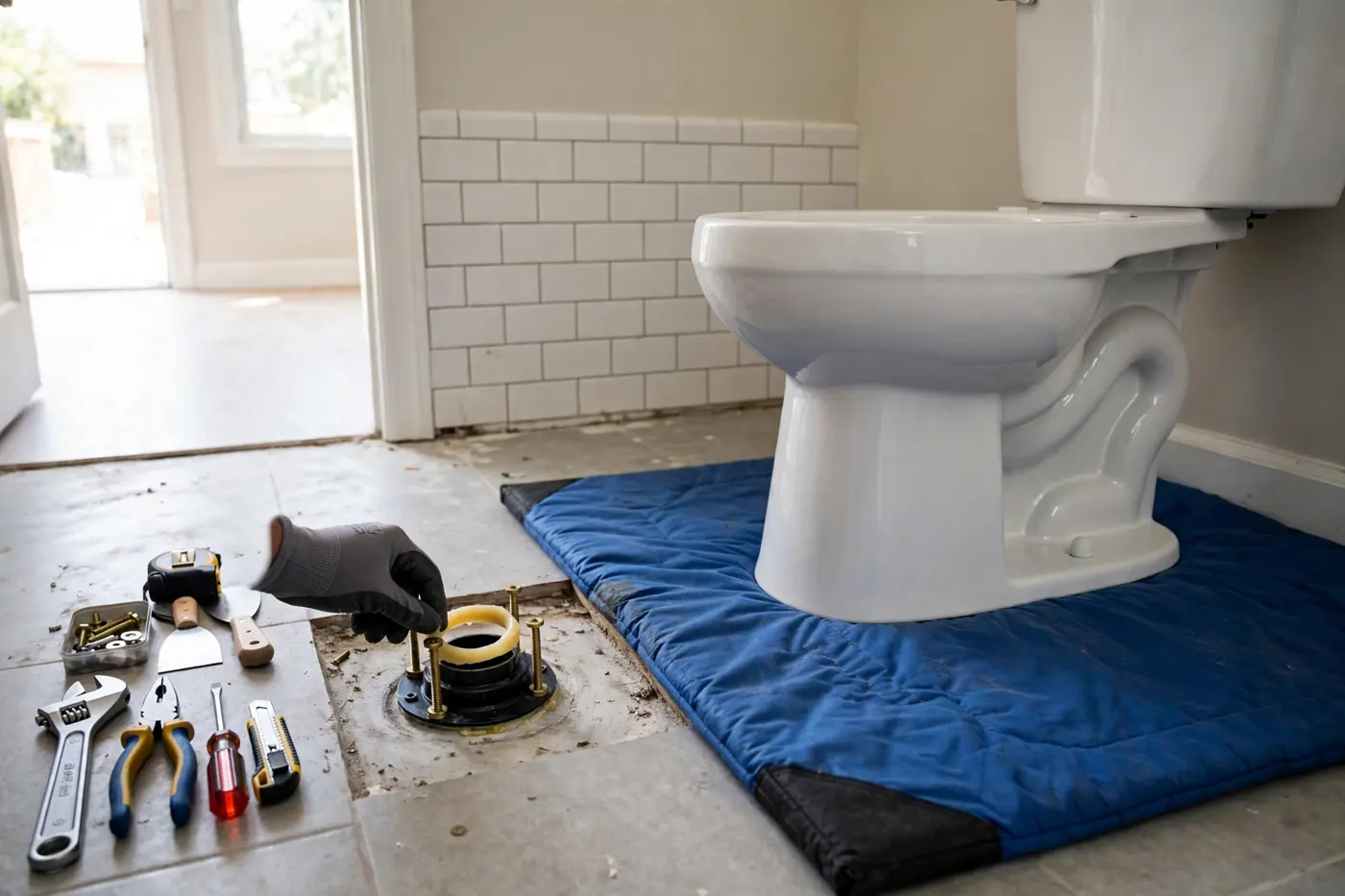
Toilet Flange Repair in Fountain Valley, CA
A rocking toilet, water at the base, or a sewer smell near the floor often starts at the flange — one call connects you with a local toilet specialist who lifts the toilet, checks the ring, and resets it firm.
📞 Call Now — (714) 410-0362The small ring that holds the whole toilet steady
The closet flange is the ring at floor level that joins the toilet to the drain pipe. The toilet bolts to it, and the seal under the toilet presses against it. When the ring cracks, rusts, or sits at the wrong height, the toilet moves, the seal fails, and water and sewer gas find a way out.
You cannot see the flange with the toilet in place, so its faults announce themselves in other ways. The clearest sign is movement. A toilet should feel like part of the floor. If it rocks forward when you sit, shifts side to side, or creaks against the tile, the bolts are no longer holding it to a sound ring. Each rock flexes the seal under the base. The seal was never made to flex daily, so it slowly opens a gap, and flush water begins to slip under the toilet instead of down the drain.
The next sign is water where it should not be. A damp ring on the floor after flushing, a stain creeping out from under the base, or a musty smell from the floor itself all point to water escaping at the flange joint. Because the leak is hidden under the toilet, it can run for months before it shows. By then the floor around the drain may be soft, and the smell may have worked into the subfloor. A third sign is odor with no water at all: sewer gas passing a failed seal gives a bathroom a stubborn smell that cleaning never quite clears, because the source sits sealed under the toilet.
- Toilet rocks, shifts, or creaks when weight is applied
- Water seeps from under the base during or after a flush
- Sewer smell near the floor that returns after cleaning
- Closet bolts spin, sit crooked, or will not draw the toilet down
- Floor feels soft or spongy in a ring around the toilet
- Caulk line at the base keeps splitting as the toilet moves
Putting fresh caulk around a moving toilet hides the symptom and traps the leak. The water keeps moving under the floor, unseen, and the ring keeps weakening. The honest check is to lift the toilet and look at the flange, the seal, and the floor with your own eyes. That single look settles every question: ring condition, flange height, bolt slots, pipe joint, and floor soundness, all visible at once.
From cracked ring to a firm, dry base
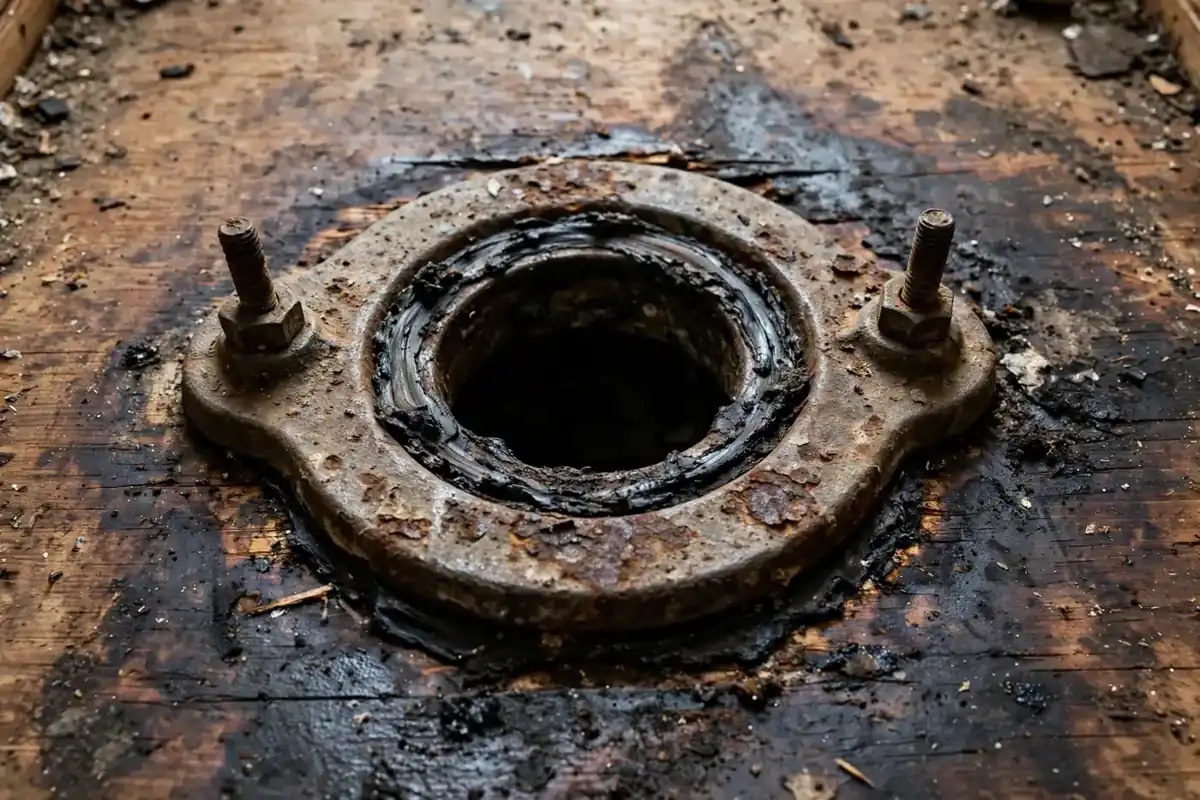
The old ring is cracked at the bolt slot and rusted thin. The bolts cannot hold, the toilet rocks with every use, and each flush pushes a little water under the base, where it soaks the floor in silence.
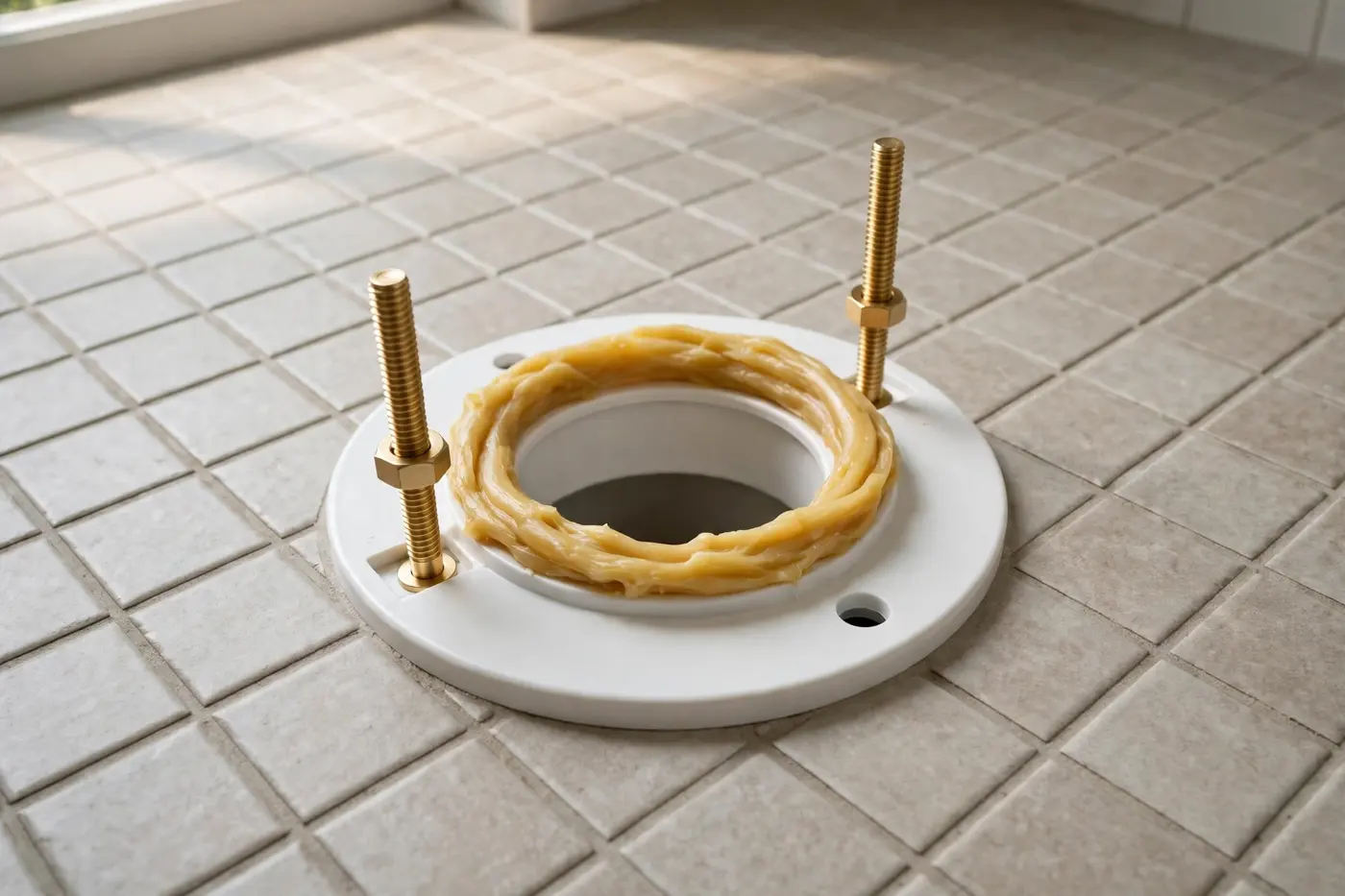
A sound ring sits level with the finished floor, fresh bolts draw the toilet down evenly, and a new seal presses flat all the way around. The toilet feels solid, the base stays dry, and the smell is gone.
After a sound flange repair, the bathroom feels different in small ways that add up. The toilet no longer moves when a tall person sits or a child climbs up. The floor beside the base stays dry through dozens of flushes. The lingering smell that no cleaner could shift fades because its path is sealed. Most owners say the same thing: the toilet feels like it did when the bathroom was new, and they stop thinking about it at all — which is exactly how a toilet should be.
How a flange repair visit runs, step by step
Flange work means lifting the toilet, so the visit follows a careful order: protect the room, lift cleanly, inspect openly, repair, then reset and test.
Water off, tank and bowl drained
The shut-off valve behind the toilet is closed, the tank is flushed dry, and the bowl water is lowered and cleared. The supply line is then unhooked so the toilet can be lifted without spills. Drop cloths protect the floor and the path out of the bathroom.
Bolts undone and toilet lifted
The bolt caps come off, the nuts are backed off the closet bolts, and the toilet is rocked gently to break the old seal, then lifted straight up and set on a protected surface. Old seal material is scraped from the toilet horn and the flange face so both are clean for inspection.
Flange, pipe, and floor inspected
With the flange fully visible, the technician checks the ring for cracks and rust, tests the bolt slots, measures flange height against the finished floor, looks down the drain for obstructions, and presses the floor around the drain to check for soft spots. You see the same view and hear the findings before any repair begins.
Repair ring fitted or flange replaced
If the flange body is sound, a repair ring is secured over the damaged bolt ring and anchored to the floor. If the flange itself has failed, it is cut out and a new flange is joined to the drain pipe and set at the right height. Height matters: the flange face should sit on top of the finished floor, not buried below it.
Fresh seal and toilet reset
A new seal is set on the flange or the toilet horn, fresh bolts stand in the slots, and the toilet is lowered straight down so the seal compresses evenly. The nuts are drawn down a little at a time on alternating sides until the toilet sits firm with no rock, without forcing porcelain against an uneven floor.
Reconnect, flush tests, and base check
The supply line is reconnected, the valve opened, and the tank filled. The toilet is flushed several times while the technician checks the base joint, the supply fittings, and the tank for any sign of water. The toilet is used and sat on to confirm it stays firm under real weight.
Flange work often pairs with wax ring replacement, since every reset needs a fresh seal, and with toilet leak repair when water has already reached the floor. If the lift shows the toilet itself is cracked or badly aged, the technician will talk through toilet replacement while the old unit is already off the floor. Our guide on how to fix a wobbly toilet walks through the same checks in print. See areas we serve for coverage across Fountain Valley and nearby cities.
Checks you can do before you call
You cannot inspect the flange itself without lifting the toilet, but you can confirm the warning signs at home and protect the floor while you wait for a visit.
First, the rock test. Sit on the closed lid and shift your weight gently, then stand and push the bowl lightly from the side with your knee. A sound toilet does not move at all. Any rock, slide, or creak counts as a fail, and the size of the movement tells you how far the fault has gone. Second, the dry test. Wipe the floor around the base fully dry, then flush three times and wait ten minutes. Run a dry paper towel around the base joint. If it comes away damp, water is leaving at the seal, not from the tank or the supply line.
Third, check the bolt caps at the base. Pop them off and look at the nuts. Heavy rust, a nut that spins with finger pressure, or a bolt that leans tells you the hold-down hardware is failing — which usually means the ring beneath it is failing too. Fourth, trust your nose. A sewer smell that is strongest at floor level near the toilet, and that cleaning does not clear, fits a broken seal at the flange far more often than it fits a dirty bowl.
Stop point: do not try to lift the toilet yourself unless you have help and a plan for where it will sit — a toilet is heavy, awkward, and easy to crack against a tub or tile edge. Do not tighten base nuts hard to stop a rock; over-tightening cracks porcelain and cannot fix a broken ring. If the floor feels soft, or water is spreading, shut the water off at the valve behind the toilet and call (714) 410-0362 during open hours.
If your checks show movement plus moisture, the two together make the case clearly: the seal has failed and the ring needs a look. That combination will not settle on its own, and each week of flushing pushes more water into the floor.
Flanges in Fountain Valley homes built in the 1960s and 1970s
Most Fountain Valley homes went up in the building waves of the 1960s and 1970s, in the tracts that now make up Green Valley, Central Fountain Valley, Park Crest, and the streets around Mile Square Park. The drain plumbing of that era relied heavily on cast iron: cast-iron drain pipes, and closet flanges made of cast iron or brass joined to the pipe with a lead-and-fiber joint. Cast iron is strong and quiet, and much of it still serves well. But fifty-plus years of flush water, cleaning chemicals, and damp bathroom air take a steady toll on the thin outer ring where the closet bolts sit.
The classic failure is a rusted or cracked bolt ear. The ring itself still joins the pipe, but the slot that holds one bolt crumbles, so that side of the toilet can no longer be drawn down. The toilet begins to rock on a diagonal, pivoting on the one bolt that still holds. Owners often respond by tightening the good side harder, which tilts the toilet, strains the porcelain foot, and crushes the seal unevenly. The seal then leaks on the loose side, water reaches the floor, and the floor weakens around the drain — which lets the whole assembly move even more. It is a slow spiral, and it explains why a toilet that rocked a little last year now rocks a lot.
Flange height: the quiet fault behind repeat seal failures
The second deep fault in these homes is height. A flange should rest on top of the finished floor, with its face level with or just above the flooring surface. In many older bathrooms, the floor has been renewed one or more times since the flange was set — tile over the original sheet flooring, or a new layer laid during a remodel — and each layer raised the floor while the flange stayed where it was. A flange left a half inch below the finished floor cannot meet the toilet horn properly. The seal has to bridge a gap it was not shaped for, and it fails early, again and again, no matter how carefully the toilet is reset.
Height faults explain the frustrating pattern of a toilet that gets a new seal every year or two and leaks again each time. The seal was never the real problem. The fix is to raise the connection: a repair flange or spacer system that brings the sealing face up to the right level, anchored firmly, so a standard seal can do its job for years. During your visit, the technician measures the flange face against the finished floor and tells you plainly which case you have — a ring fault, a height fault, or both together.
Floor rot rings and what they mean
When a flange joint leaks for a long time, the water does not spread evenly. It follows the drain opening and soaks the wood in a ring around the pipe. Builders call this a rot ring: a circle of softened subfloor centered on the flange. You can often feel it before you can see it, as a slight give in the floor right beside the toilet. A repair ring needs sound wood or solid anchoring to hold its screws, so the technician checks the ring of floor around the drain with care. Minor surface softness can often be worked around with the right anchoring. A floor that flexes under hand pressure needs the weakened section renewed before any flange can hold — and you will hear that before work starts, not after the toilet is already off.
The good news is that flange faults, caught at the rocking stage, are contained jobs. The drain pipe below is usually sound, the floor is usually firm beyond the immediate ring, and a repair ring plus a correct-height reset restores the joint fully. Waiting is what turns a ring job into a floor job, which is why a rocking toilet deserves a prompt call rather than a wait-and-see season.
Repair ring vs full flange replacement
Both approaches end with the same goal — a firm toilet on a dry seal. The right one depends on what the lift reveals about the ring, the flange body, and the pipe.
Repair ring
- Fits over the existing flange when the body and pipe joint are sound
- Replaces only the cracked or rusted bolt ring
- Anchors to the floor with screws around the ring
- Toilet is lifted, ring fitted, and reset in the same visit
- Pairs with spacers when the flange also sits a little low
Full flange replacement
- Needed when the flange body is cracked or the pipe joint has failed
- Old flange is cut out and a new flange is joined to the drain pipe
- New flange is set at the correct height for the finished floor
- The stronger choice when the drain connection itself is damaged
- Also the moment to correct a flange left far below floor level
The technician makes this call with the toilet lifted and the parts in full view, and shows you the crack, the rust, or the height gap that drives the choice. If a repair ring will hold for years, that is the recommendation. If the flange body has failed, a ring would only hide the fault for a season, and you will hear that plainly too.
Toilet flange repair questions from Fountain Valley homes
What are the signs I need toilet flange repair?
Signs you need toilet flange repair include a toilet that rocks when you sit, water seeping from under the base after a flush, a sewage smell that lingers near the floor, and loose closet bolts that will not hold tight. Any one of these means the connection between the toilet and the floor drain needs a close look. The technician lifts the toilet to confirm the flange condition before any work starts.
How does a technician check the flange during toilet flange repair?
During toilet flange repair, the technician shuts off the water, drains the tank and bowl, and unbolts and lifts the toilet so the flange is fully visible. The ring is checked for cracks, rust, and broken bolt slots, and its height is checked against the finished floor. The floor around the drain is also checked for soft or damp spots. You hear the findings and the options before anything is fitted.
Can a repair ring handle my toilet flange repair, or do I need a full replacement?
A repair ring can handle your toilet flange repair when the flange body and drain pipe are sound and only the bolt ring is cracked or rusted. A full flange replacement is the right call when the flange itself is cracked, sits far below floor level, or the drain pipe joint has failed. The technician shows you the condition of the ring and the pipe so the choice rests on what is visible, not on a guess.
Does toilet flange repair include a new seal under the toilet?
Yes. Toilet flange repair always ends with the toilet reset on a fresh seal, because the old seal cannot be reused once the toilet has been lifted. The technician cleans the flange face, sets the new seal, lowers the toilet straight onto the bolts, and snugs the nuts evenly. Flush tests then confirm the base stays dry and the toilet sits firm with no rock.
What happens if the floor is soft during toilet flange repair?
If the floor is soft during toilet flange repair, the technician will show you the damp or weakened area around the drain and explain what it means for the repair. A flange can be secured to sound framing in many cases, but a floor section that has rotted through needs building work before the toilet can sit firm. You will hear the options plainly before any further work starts, so there are no surprises mid-job.
How long does toilet flange repair take in a typical home?
Toilet flange repair in a typical home is done in one visit when a repair ring or a standard flange swap is all the job needs. The visit covers lifting the toilet, the ring or flange work, a fresh seal, resetting the toilet, and repeat flush tests. Jobs that uncover floor damage or a drain pipe fault take longer, and the technician explains the added scope before going ahead.
Rocking toilet? Get the flange checked.
Call during open hours — Mon–Fri 7:00 AM–10:00 PM, Sat 8:00 AM–10:00 PM, Sun 7:00 AM–9:00 PM — and one call connects you with a local toilet specialist for Fountain Valley.
📞 Call Now — (714) 410-0362 Prefer email? [email protected]